 AgentX v0.21.273 · alpha AgentX v0.21.273 · alpha
 A self-hosted platform you can see inside. Six thinking patterns, four memory types that persist and learn, teams of agents that delegate to each other, and any model you bring — with every decision the loop makes streamed live.
tar xzf agentx-deploy.tar.gz && cd agentx-deploy cp .env.example .env docker compose up -d A mind you can watch work — reasoning, memory that learns, and a context window that never overflows.
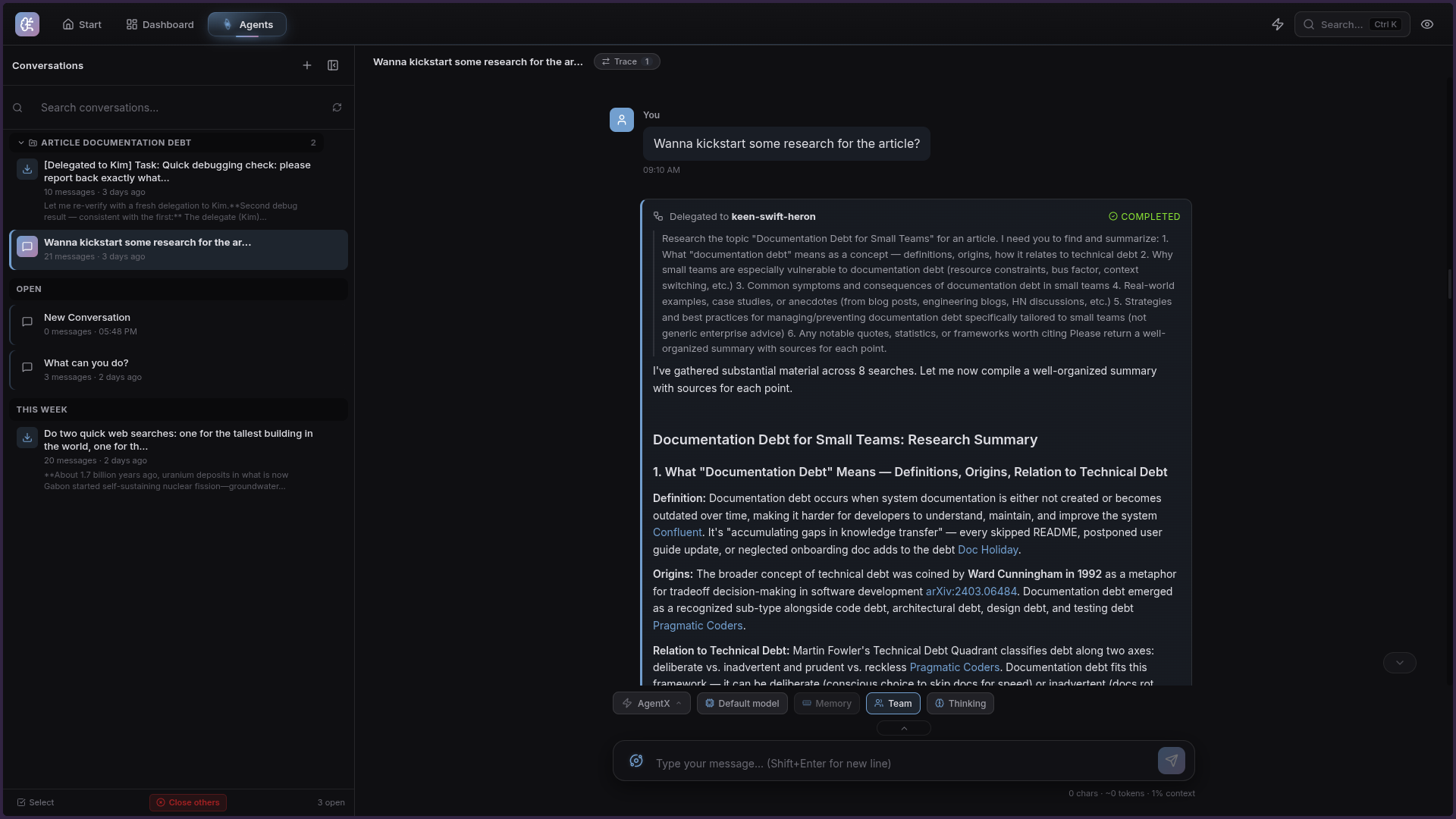
Watch the agent think, call tools, and hand work to teammates — live. The reasoning, every tool call and result, and each delegation stream to screen; nothing happens in the dark.
Learn moreFour memory types — episodic, semantic, procedural, and working — with five recall techniques and background consolidation, so agents remember and sharpen across conversations.
Learn moreOversized tool outputs are compressed and stored for retrieval, and Focus-style trajectory compression keeps long tool loops inside the window — so the agent stays coherent on long tasks.
Learn moreBuild an agent's persona from layered, reusable prompt sections over a global base — with an LLM-backed enhancer that sharpens a prompt on demand.
Learn moreNot one overloaded assistant — a roster of specialists that delegate, coordinate, and keep you in the loop.
A lead hands subtasks to specialist teammates over a shared memory channel — with @-mention routing, ad-hoc agent-to-agent delegation, and per-agent tool isolation. Watch them work it out.
Learn moreA dedicated agent runs alongside your conversation and briefs you on it — by voice or text — without ever entering the transcript. Step away, come back, and ask what your agents have been doing.
Learn moreConnect external tool servers over MCP, or turn any Python function into an agent tool with a single @register_tool decorator — no separate server for in-process tools.
Learn moreYou own the whole stack — the server, the models, and every platform it runs on.
Run your own server — no SaaS, no lock-in. One interface across LM Studio, Anthropic, OpenAI, OpenRouter, and Vercel AI Gateway; bring the models you already pay for.
Learn moreOne Tauri v2 client across Windows, macOS, and Linux, an Android build (mobile-ready), and a browser / PWA mode. Same app, everywhere you work.
Learn moreAgentX is MIT-licensed and built in the open — read every line, fork it, and run it as long as you like. No vendor can switch it off.
Learn moreA lead hands research to a specialist teammate and synthesizes the result — the delegation, its completed status, and the full trace all render inline. Nothing happens off-screen.
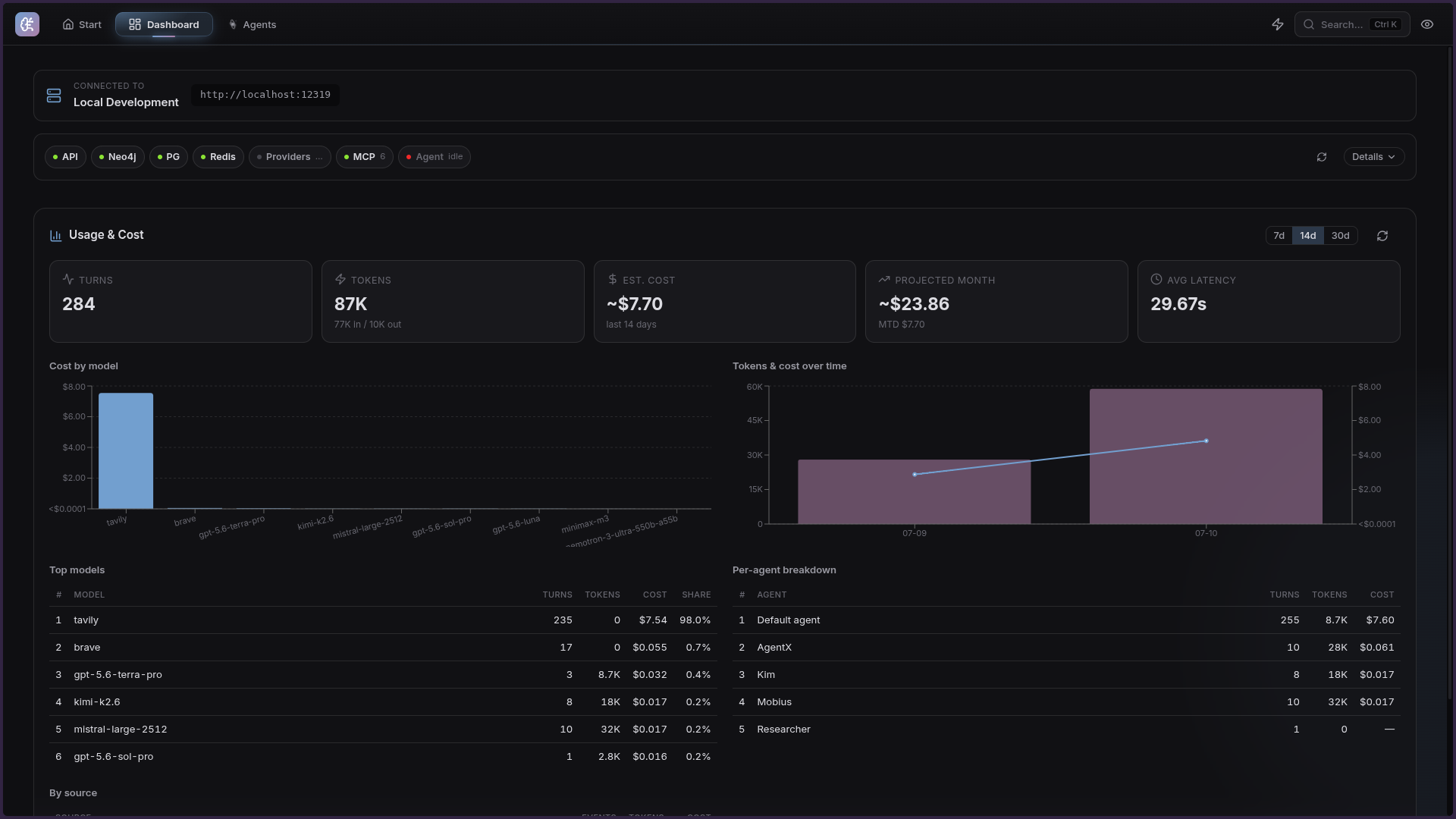
A live dashboard on your own server: spend by model and by agent, token counts, month projections, and latency — so you always know exactly what your agents cost.
Per-request orchestrator. Sessions, context budgeting, tool loop, output parsing.
Six thinking patterns — native, step-by-step, step-back, reflection, deep reflection, and consensus — auto-selected per task, with a Tree-of-Thought / ReAct kit for offline runs.
Speculative decoding, multi-stage pipelines, N-best candidates.
Connect to external tool servers over stdio, SSE, or streamable HTTP.
One interface across LM Studio, Anthropic, OpenAI, OpenRouter, and Vercel AI Gateway — swap models per request.
Profile-based composition with a global prompt layer. Sections compose at runtime.
Four memory types with five recall techniques, per-agent self-knowledge, and background consolidation.
Agent Teams — a lead hands subtasks to specialist teammates over a shared channel, with @-mention routing and ad-hoc agent-to-agent delegation.
Every component sits behind a small, explicit interface. Reasoning picks the strategy. Drafting picks the candidate. The provider picks the model. Memory picks what to remember. The agent loop binds them.
Swap any one out without touching the rest — the surface contracts don't move.
AgentX stands on the shoulders of the open-source ecosystem. A few of the projects that make it work:
The same glassbox platform — persistent memory, agent teams, reasoning, and your choice of model — without standing up a thing. Bring your keys; we run the rest.